David Shriver & the Road to Independence in Maryland
The 250th anniversary of American independence reminds us that many American Patriots inspired the break from England, and not just headliners like George Washington or Thomas Jefferson. The cause of liberty involved Patriots at all levels–including here in what is now Carroll County, then part of Frederick County and Baltimore County. The Union Mills Homestead has a variety of exhibits and programs interpreting the founding era and honoring local Patriots.
The Shriver Family’s Early Years & Growing Resentment to British Rule
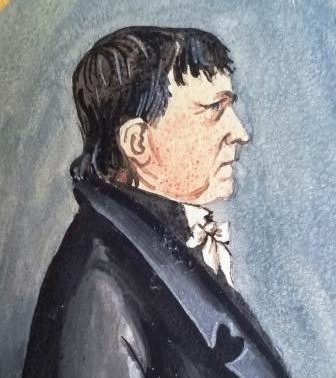
David Shriver, Sr., 1835-1826, father of the brothers who founded Union Mills
While Union Mills did not exist in 1776, its founders were alive and well, living along Little Pipe Creek with their parents, David and Rebecca Shriver. The Shrivers settled in Maryland in 1760. David Shriver was the son of German immigrants who in 1721 fled an area of Germany known as the Palatinate (the Rhineland), where the family had suffered under warring and petty princes and potentates. Shriver was no fan of despotic rule and supported each major step towards American independence.
As schoolchildren can recite, taxation without representation was a core concern. When the British Parliament passed the Tea Act in 1773, simmering resentment against English taxation of the American colonies rose to a full boil, resulting in the Boston Tea Party. In early 1774, the British responded with the Coercive Acts, closing the port of Boston and putting the city under military control. Americans found this “intolerable.”
Many in Frederick County deplored the closing of Boston harbor, and on June 20, 1774, a large courthouse gathering urged the colonies to refuse all imports from and exports to Great Britain. The group resolved “that the town of Boston is now suffering in the common cause of America, and that it is the duty of every colony in America to unite in the most effectual means to obtain the repeal of the late act of parliament for blocking up the harbour of Boston.”
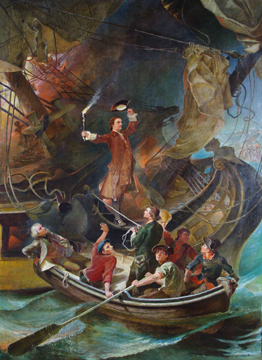
Burning of the Peggy Stewart, Francis Blackwell Mayer (1827-1899), in the Maryland State House, courtesy Maryland State Archives, MSA SC 1545-1111.
Days later, a Provincial Convention in Annapolis joined Maryland with other colonies in supporting the import/export ban, which the Continental Congress adopted that October as a united position. This Convention, and following assemblies through 1776, served as the de facto government of Maryland outside normal legal procedures.
Marylanders had their own tea party to reinforce the boycott, acting with defiance, not fear. On October 19, 1774, Anthony Stewart and his brig Peggy Stewart attempted to enter Annapolis Harbor carrying a load of English Tea on which required duties were paid.
Angry mobs threatened Stewart for violating the resolutions barring the importation of English goods. The crowds forced Stewart to scuttle the ship and set it ablaze — a vivid demonstration of revolutionary zeal in Maryland.
David Shriver Joins the Revolutionary Cause
David Shriver fully supported the revolutionary fervor. On November 18, 1774, Shriver formally joined in the “association” adopted by the Continental Congress. And on January 24, 1775, at a meeting at the Frederick courthouse, Shriver joined the county’s committee of observation to police any violations of the association. These actions came at great risk; as recounted in his obituary many years later, “[m]ore than once he was warned that ‘King George’s men’ had set a price on his head.” (David Shriver Obituary: The Star and Sentinel [Gettysburg, Pennsylvania] Wed, Feb 15, 1826)
Resistance escalated to armed conflict at Lexington and Concord, and on July 26, 1775, the Maryland Convention approved “opposition by arms” to British forces. Shriver fully supported the military effort. He and neighbor William Winchester rallied “able-bodied freemen” in the area to join local muster rolls. And in June 1776, when several companies of Frederick County militia formed into a Battalion, Shriver took a commission as a Lieutenant Colonel.
Independence and a New Form of Government
Finally, on June 28, 1776, Maryland’s Convention authorized its delegates in congress to declare the united colonies “free and independent states.” Again, Shriver fully embraced independence. On July 3, 1776, the Convention decided that a separate assembly should be elected to form “a new government, by the authority of the people only, and enacting and ordering all things for the preservation, safety, and general weal of this colony.” The Convention selected David Shriver and two others to “be judge of and hold the election for” the district in Frederick County that included the Westminster area.
The county elected Shriver as one of its representatives, and on August 14, 1776, Shriver appeared in Annapolis to write a “declaration and charter of rights, and a plan of government” for the new State of Maryland.
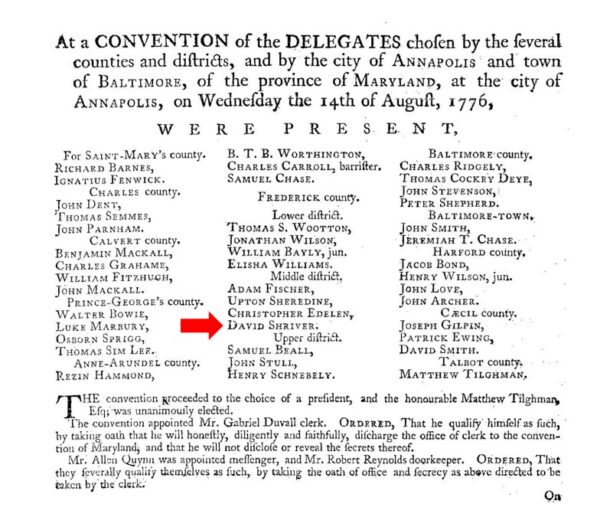
The record of proceedings for the Maryland Constitutional Convention, which met in Annapolis, MD, on August 14, 1776, with a highlight as to David Shriver, a representative for the Middle District of Frederick County.
The Constitutional Convention’s work continued until November, when it adopted a new Declaration of Rights and Constitution and Form of Government. This document, for the first time, provided citizens of Maryland with key guarantees such as freedom of speech, religion, and redress, along with the new form of state government.
By their efforts, David Shriver and his fellow Maryland Patriots acted to achieve and “maintain the freedom and independency of the United States with their lives and fortunes.” Their progeny and indeed all Americans should be eternally grateful.
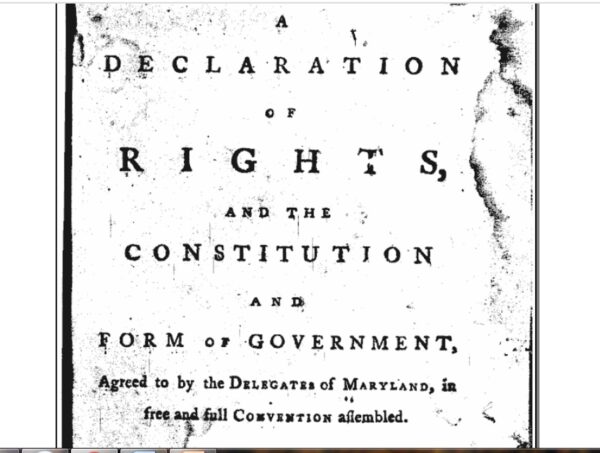
Cover of A Declaration of Rights and the Constitution and Form of Government, Agreed to by the Delegates of Maryland, in free and full Convention assembled. Annapolis: Printed by Frederick Green. [1776.], Library of Congress, courtesy Maryland State Archives.
Upcoming America 250 Event:
“Celebrating Self-Governance: The 250th Anniversary of Maryland’s First Free Election After Independence and the 1776 Constitutional Convention”
- Date: Sunday, August 16, 2026
- Time: 2 p.m.
- Location: Union Mills Homestead Tannery
- Speaker: Hon. Joseph M. Getty, Senior Justice, Supreme Court of Maryland
Revolutionary War Living History Event:
“1776: Maryland Goes To War” was held at the Union Mills Homestead on June 20-21, 1776 to recreate for our visitors the the difficult days preceding our nation’s independence. The event explored the many challenges facing our country’s founding generation.
This living history weekend at the Union Mill Homestead was modeled on a 1776 recruiting event and featured reenactors portraying civilians and soldiers. Visitors were asked questions Americans were forced to confront at the dawn of the Revolutionary War and independence. Loyalty or rebellion? Violence or pacifism?
Where do you fall, and who would you support?
Some highlights:
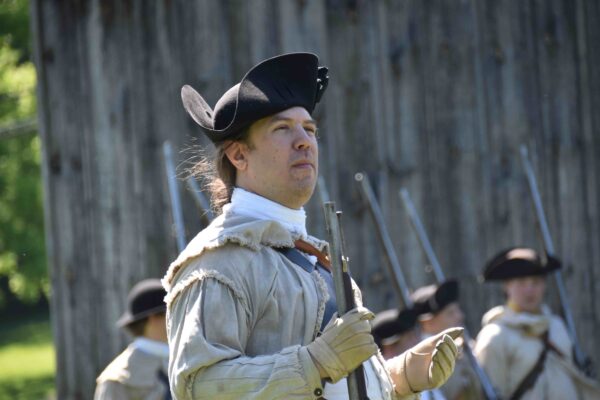
Revolutionary War reenactors providing a living history experience at the Union Mills Homestead on June 20, 2026.
Event Link: https://unionmills.org/events/1776-maryland-goes-to-war/