
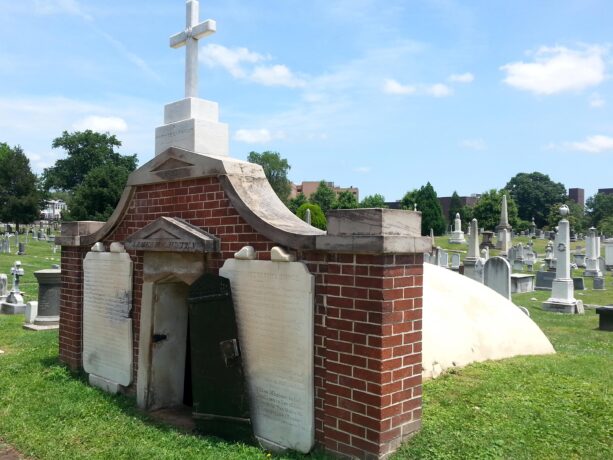
Causten Vault Links Shrivers To First Lady Dolley Madison
So what do the Union Mills Homestead and Dolley Madison have in common? Turns out there are some interesting links between the Shriver family at the historic site north of Westminster, MD and our Nation’s fourth First Lady. Although the story starts at the Union Mills Homestead, it also involves the White House and a cemetery in Washington, D.C.
Background: Union Mills’ Founding and a Trip to Washington
In 1797, Andrew Shriver and his brother, David Shriver, Jr., established Union Mills as a joint enterprise, centered on a gristmill and sawmill. The union of the mills and the brothers provided inspiration for the name.
By early 1811, David Shriver, Jr. had left Union Mills to pursue opportunities as a civil engineer, developing a reputation in turnpike road construction. David was still establishing himself in the fast-growing new nation, and looked to his brother for help. In February, 1811, Andrew traveled to the Nation’s capital to lobby officials there on his brother’s behalf.
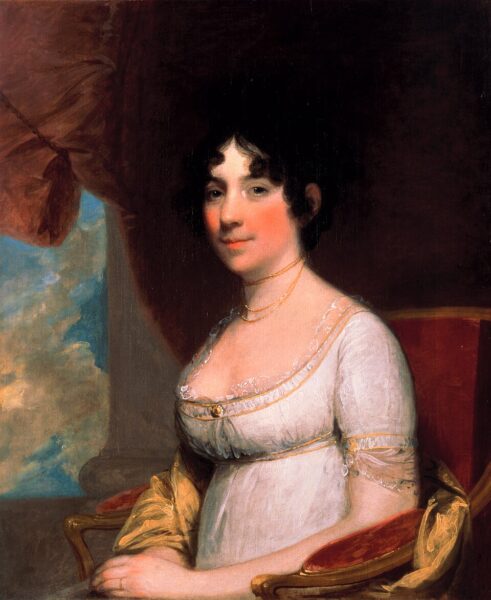
Gilbert Stuart Portrait of Dolley Payne Madison, 1804. The portrait was owned for a time by Anna Payne Causten (Dolley Madison’s niece) and then, after her death, the Causten family. (White House Historical Association, White House Collection, Public domain, via Wikimedia Commons)
Andrew arrived in Washington on Saturday, February 9, 1811, after a most “unpleasant ride in the Stage thro the worst roads I ever saw….” The next week, Andrew met with the Secretary of the Treasury, Albert Gallatin, the official planning the construction of a new, federally-funded road authorized by Congress to be built from Cumberland to Wheeling. Andrew followed up with several visits with President Madison.
While in Washington, Andrew had the opportunity to meet the First Lady, Dolley Madison. In a letter to his wife, Betsy, Andrew wrote that he also “was at Madam Madison’s to tea, where I was introduced to all the foreign ministers & saw all the most distinguished ladies of the Nation.” (Of note, Andrew did not approve of the ladies’ dress, finding them “nearly half naked.”)
As a result of this trip, however, as well as his brother’s technical skills, Secretary Gallatin appointed David Shriver, Jr. as Superintendent of Construction for the Cumberland Turnpike, what eventually became known as the National Road.
While David was awarded the road job, Andrew returned to Union Mills. Six generations of the Shriver family ended up living at the Union Mills Homestead over a span of a century and a half. Many years after the enterprise was founded, the historic site was preserved for the public to visit, featuring a house museum and working gristmill, operated by the Union Mills Homestead Foundation that the Shriver family established in 1964.
Vault Restoration at Congressional Cemetery
It was much later, in the 21st century, that team members from the Union Mills Homestead pieced together the “rest” of the story—with the help of a research team from of all places the Smithsonian’s National Museum of Natural History (NMNH).
In 2009, esteemed NMHN forensic anthropologist, Douglas Owsley, received a request for assistance from Congressional Cemetery in Washington, D. C. The cemetery had a number of historic vaults that had deteriorated and needed restoration.
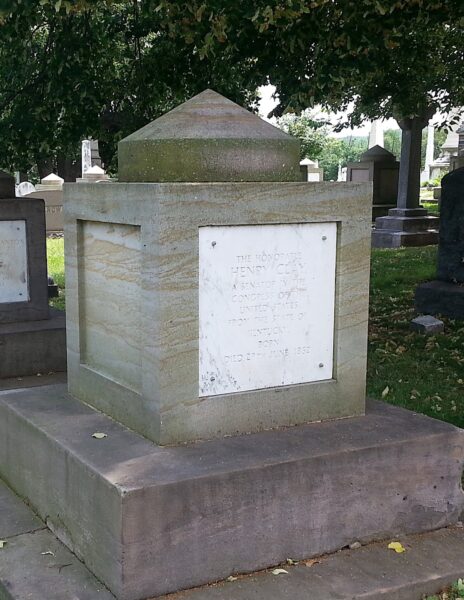
Henry Clay’s grave marker at Congressional Cemetery in Washington, D.C. (Sam Riley photo)
For much of our history, Congressional Cemetery has served as the final resting place for notables from the Nation’s capital, including the likes of John C. Calhoun and Henry Clay. Also buried here are both J. Edgar Hoover and Elbridge Gerry, signer of the Declaration of Independence and Massachusetts governor who coined the word gerrymander. So too are Mathew Brady and John Philip Sousa. At least three U.S. Presidents were interred there temporarily after their deaths, in the cemetery’s Congressionally-funded public vault, before being moved to their final resting places.
One historic vault, dating to 1835, was a particular concern. The vault was that of James H. Causten and his family. Causten (1788-1874) was a successful lawyer and diplomat who was born in Baltimore and later lived in the Washington area. He owned a large estate along the east side of the Rockville Turnpike. One daughter, Mary Elizabeth, married Manuel Carvallo, Chilean Minister to Belgium, France and England. Another daughter, Henrietta, married Joseph Shriver—the youngest son of Andrew and Elizabeth Shriver of Union Mills.
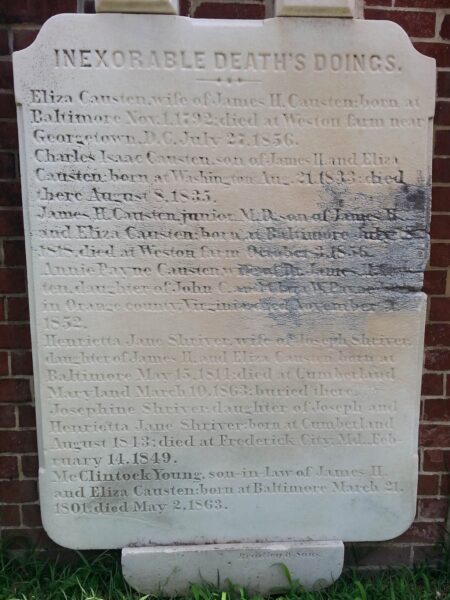
“Inexorable Death’s Doings” – Inscription on a marble marker on the Causten Vault. (Sam Riley photo)
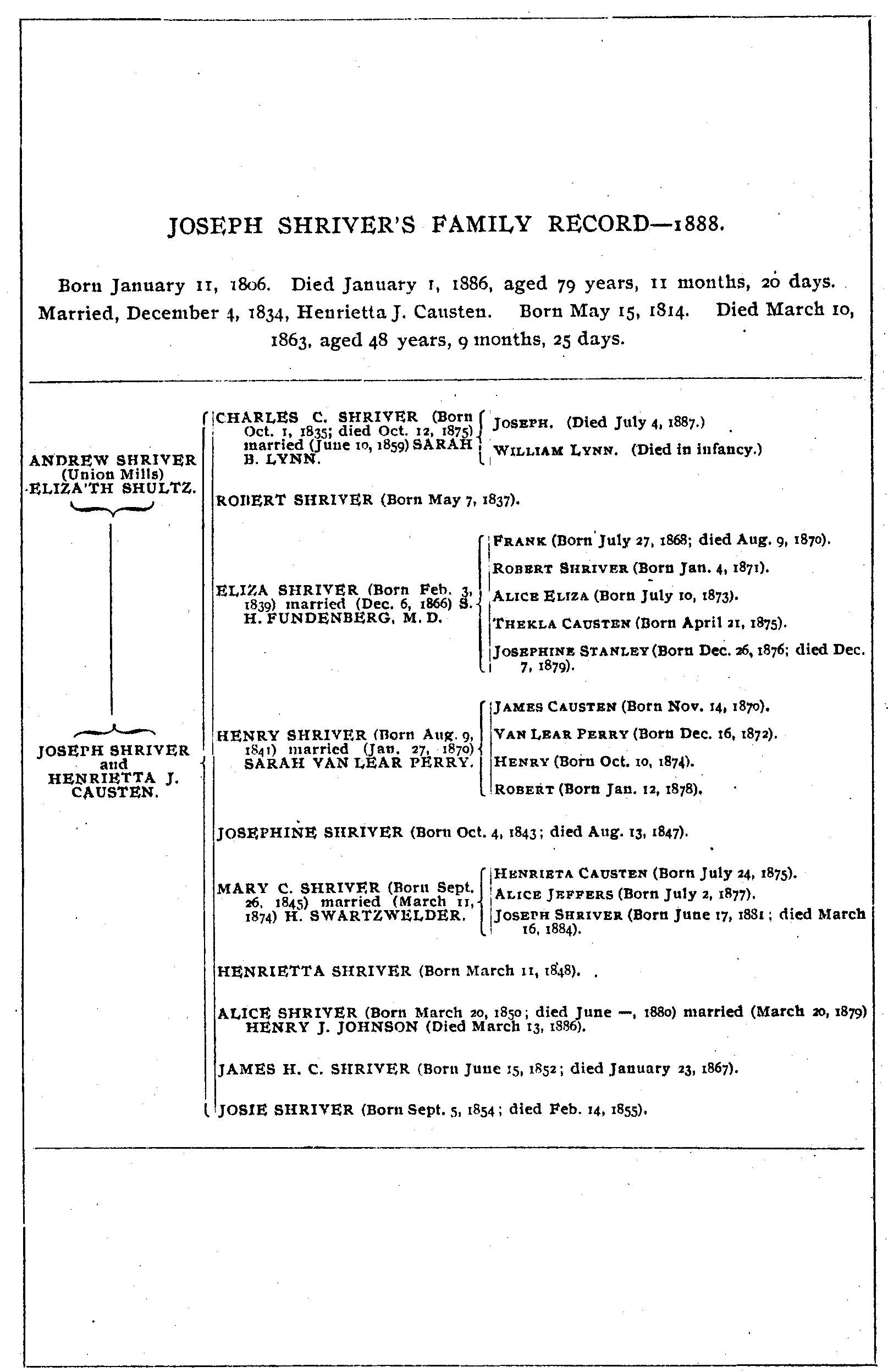
James H. Causten lived to the impressive age of 86. Much of his family was not so lucky. His children’s families, particularly the Carvallos and Shrivers, experienced the pain of several childhood deaths. This included Josephine Shriver, granddaughter of both James H. Causten and Andrew Shriver. Josephine died in 1847, just four years old. While her parents were eventually interred in Cumberland, young Josephine was buried in the Causten family vault at Congressional Cemetery with other members of the Causten and Carvallo families.
By 2009, the vault’s deteriorated mortar, particularly in its barrel roof, posed an imminent structural risk. Work on the vault to prevent its collapse would require removal of all its contents—including not just the remnants of caskets but also human remains, all chaotically pancaked together on the vault’s floor after failure of coffin shelving at some point in time.
Removal of the vault’s contents would require the care and knowledge of someone like the experts at nearby NMNH. And the project also offered the potential for fascinating research into 19th century life and death, what Dr. Owsley called an “indoor archaeological investigation.” Owsley and his team of archaeologists and anthropologists carefully examined and sorted each layer of the vault’s contents and removed everything to a NMNH laboratory for study.
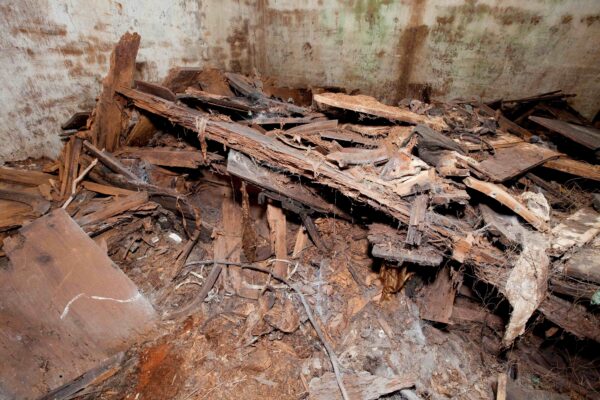
The interior of the Causten Vault prior to its renovation. Dampness and natural deterioration of 19th-century coffins and supporting platorm resulted in a three-foot-deep pile of broken coffins and human remains. (Photo by Chip Clark / Smithsonian Institution)
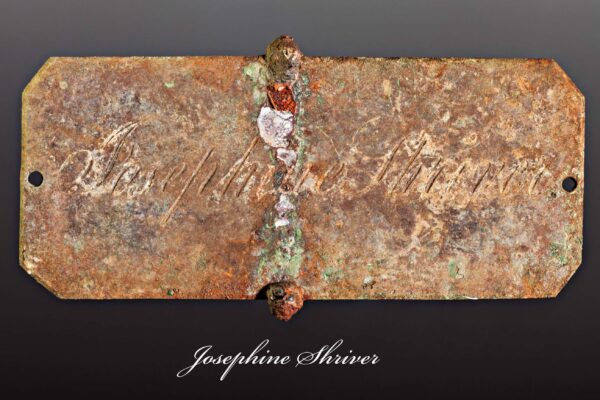
Silver-plated nameplate recovered from the Causten Vault, from the coffin of Josephine Shriver, the daughter of Henrietta Causten Shriver and Joseph Shriver. Josephine died from unknown causes in 1847 when she was only 4 years old. (Photo by James Di Loreto / Smithsonian Institution)
NMNH researchers eventually determined that the vault contained remains of 16 people. This included 13 skeletons with three others still preserved in iron coffins. Several bodies, whose coffins had been at the bottom of the vault, had completely disintegrated. Among the casket artifacts found: a coffin nameplate for young Josephine Shriver.
Dolley Madison and the Iron Caskets
The iron coffins were of particular interest. These coffins featured an airtight design, acting to preserve human remains by minimizing the transfer of air, slowing a body’s decomposition. In the 19th century, this facilitated transportation of bodies greater distances to return a deceased person to their families. In addition to their airtight design, Iron coffins typically included an oval glass viewing window that allowed family to view their loved ones while avoiding odor or disease.
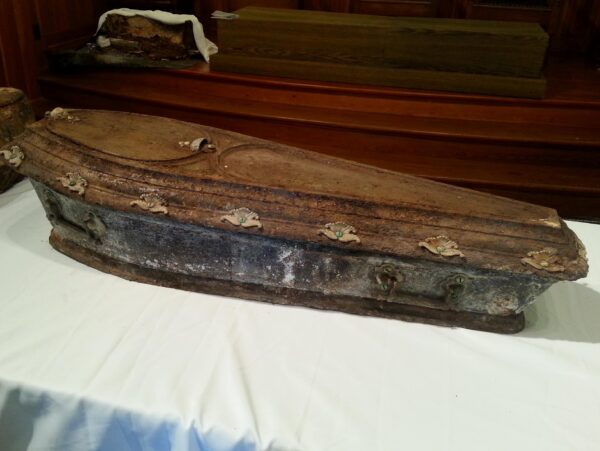
An iron casket retrieved from the Causten Vault at Congressional Cemetery. (Sam Riley photo)
According to archaeologist Scott Warnasch, “cast iron caskets caught the public’s eye in 1849 when beloved former first lady Dolley Madison was laid out in one in a large public funeral ceremony.” As it turns out, after Dolley Madison’s death, she was interred at Congressional Cemetery in the public vault.
Dolley Madison’s niece, however, did not think the public vault was appropriate for a first lady. That niece was none other than James Causten’s daughter-in-law, Anna C. “Annie” Payne Causten (1819 – 1852), wife of Dr. James H. Causten, Jr. (1818 – 1856). A few years after her death, Dolley Madison’s body was moved from the public vault to the Causten Vault, where she remained until 1858, when her remains were finally moved to Montpelier to rejoin her husband, President James Madison.
Thus, Dolley Madison and Andrew Shriver’s granddaughter, Josephine, were united in death for a few years, decades after Andrew met Dolley on his 1811 trip to Washington, D.C. What interesting stories come weaved together as we continue to mine the history of the Union Mills Homestead!
Epilogue
Several of Josephine Shriver’s surviving siblings married and ended up with prolific progeny. Josephine’s brother, Henry Shriver, was the grandfather of R. Sargent Shriver, Jr., who served as first Director of the Peace Corps and Ambassador to France, and married Eunice Kennedy.
In 2014, after Congressional Cemetery completed the restoration of the Causten Vault, members of the Shriver family came to Congressional Cemetery for a reinterment of remains of those who had been buried there. Among those in attendance was Timothy Shriver, longtime chair of the Special Olympics, and a son of Sargent Shriver and Eunice Kennedy Shriver. NMNH researchers provided the family with their findings including intimate details relating to their ancestors’ burials, such as neck medallions and rosary beads buried with the deceased, reflecting their family’s Roman Catholic faith.
Genealogy link for Josephine Shriver is available here.
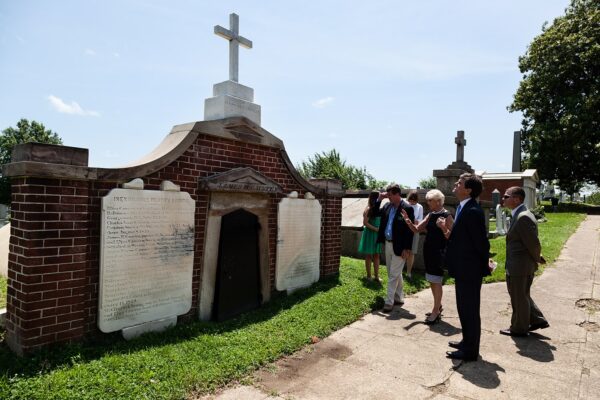
Members of the Shriver Family visiting the Causten Vault at Congressional Cemetery during a reinterment in August, 2014. (NMNH Photo)